
Floor Cleaning Machines: A practical buyer’s guide to types, specs & value
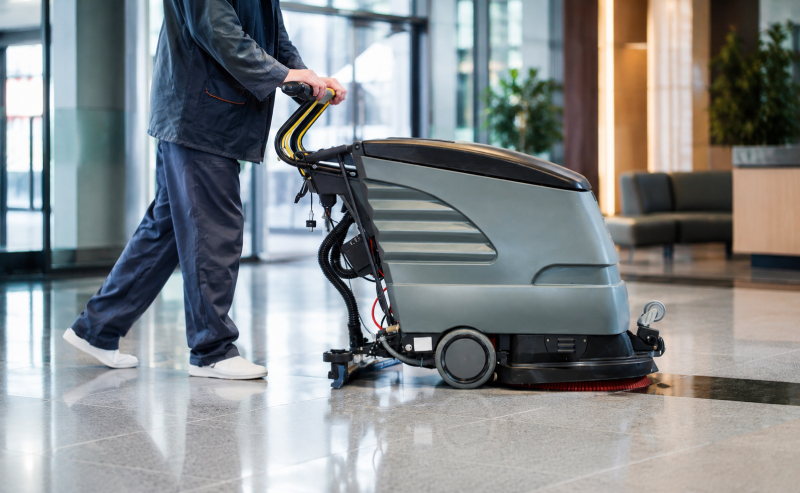
Floor cleaning machines are purpose-built industrial assets — and buying the right one means understanding exactly what each type does, what specs matter, and what separates a solid used unit from a money pit. Whether you’re equipping a warehouse, a logistics facility, a municipal building, or a commercial property portfolio, this guide covers what you need to know before you bid or buy.
What are the main types of floor cleaning machines?
The term covers several distinct machine categories, each designed for a specific cleaning task. Buying the wrong type wastes money and leaves the job undone.
Floor Scrubbers
Floor scrubbers use water, cleaning solution, and rotating scrub brushes or pads to deep-clean hard floors. They’re the workhorse of warehouse, retail, and institutional facilities. Key specs to evaluate: cleaning path width (typically 20″–36″ for walk-behind units, wider for ride-on), tank capacity (solution and recovery tanks), and brush pressure. Ride-on scrubbers handle large square footage efficiently; walk-behind units suit tighter spaces and smaller footprints.
Floor Sweepers
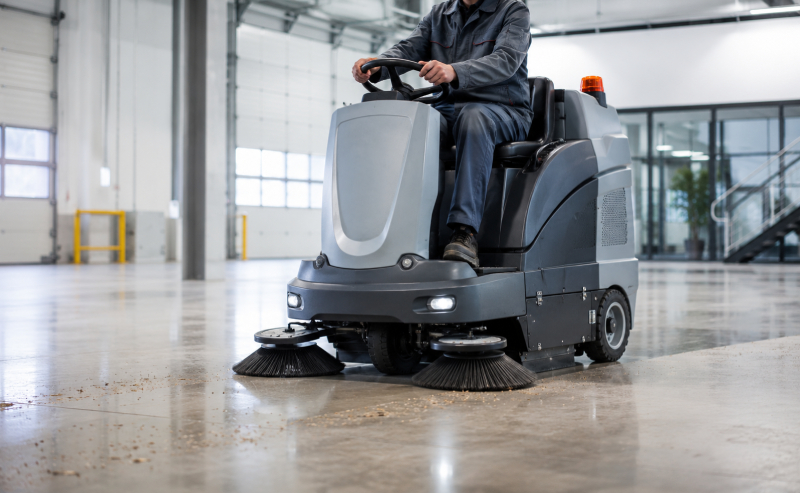
Sweepers collect dry debris — dust, grit, packaging material — using brushes and a hopper rather than water. They’re essential in manufacturing plants, distribution centres, and outdoor paved areas. Evaluate hopper capacity, brush type (cylindrical vs. disc), and whether the unit is battery-electric, propane, or diesel. Outdoor and heavy-industrial sweepers are significantly larger and more robust than indoor units.
Floor Burnishers
Burnishers operate at very high RPM — typically 1,500–3,000+ — to create a high-gloss finish on vinyl, tile, and sealed concrete. They don’t clean; they polish. If your facility requires a mirror-like finish on finished floors, a burnisher is a separate purchase from your scrubber. Check pad size, motor wattage, and whether the unit is propane or electric.
Floor Buffers
Buffers operate at lower RPM than burnishers (175–800 RPM) and handle scrubbing, stripping, and light polishing. A single-disc buffer is more versatile than a burnisher for facilities that need one machine for multiple tasks. Pad type determines the function — strip pads for removing old finish, scrub pads for cleaning, polish pads for finishing.
Floor Scrapers
Scrapers are specialty machines for removing adhesive, old tile, carpet, and coatings from concrete or subfloor surfaces — primarily used in flooring renovation and construction. They’re not everyday cleaning equipment, but they’re a critical purchase for flooring contractors and facilities undergoing refits.
Specs to consider when buying a floor cleaner
Focusing on the right specs separates buyers who get value from those who end up with an underperforming or unreliable machine.
Cleaning path width — Wider is faster across open floor. A 28″ ride-on scrubber covers the same area four times faster than a 20″ walk-behind. For warehouses over 20,000 sq ft, prioritise ride-on units.
Power source — Battery-electric units are quieter and emissions-free, making them standard for indoor commercial use. Propane units offer longer run times and suit large facilities with charging constraints. Diesel is typically reserved for outdoor and heavy-industrial sweepers.
Battery condition (electric units) — On used electric machines, battery health is the single most important factor. Worn batteries reduce run time sharply. Check the battery age, type (flooded lead-acid vs. AGM vs. lithium), and number of charge cycles if that data is accessible.
Hours of use — Like any powered asset, high-hour machines carry more wear risk. Assess hours alongside maintenance history. A well-maintained 1,200-hour Tennant or Nilfisk unit can still represent excellent value.
Brand and parts availability — Tennant, Nilfisk, Clarke, Karcher, and Factory Cat are the established names with widespread parts and service networks. Buying an obscure brand at a discount can be a false economy if consumables and parts are hard to source.
Ride-ons vs walk behind
Ride-on machines are worth the investment when your floor area exceeds roughly 15,000–20,000 sq ft. Below that threshold, a walk-behind unit is typically more cost-effective and manoeuvrable. Ride-on scrubbers and sweepers also allow operators to work for longer without fatigue, which matters in multi-shift facilities.
Walk-behind units are better suited to:
– Facilities with narrow aisles and tight corners
– Multi-level buildings (easier to move between floors)
– Lower budgets or lower cleaning frequency requirements
Ride-on units are better suited to:
– Large warehouses, distribution hubs, and manufacturing floors
– Airports, convention centres, and large retail spaces
– Operations where labour efficiency is a priority
What you should inspect on a used floor cleaning machine
Buying used equipment requires a structured inspection. Run through this checklist before committing:
- Squeegee blades — Check for cracking, uneven wear, or missing sections. Replacement blades are low-cost but worn blades cause poor water recovery.
- Scrub brushes or pads — Assess bristle length and condition. Worn brushes reduce cleaning effectiveness significantly.
- Recovery tank — Inspect for cracks, odour (sign of stagnant water damage), and drain valve function.
- Solution tank — Check for leaks, cracks, and sediment build-up.
- Drive system — Test forward and reverse engagement on ride-on units. Listen for unusual noises from drive motors.
- Lift system (scrubbers) — The scrub head should raise and lower smoothly with no grinding or hesitation.
- Battery and charger (electric units) — Test run time under load if possible. Confirm the charger is included and functional.
- Frame condition — Surface rust on steel frames is cosmetic; structural corrosion near welds is a red flag.
- Hours meter — Cross-reference stated hours with visible wear on high-contact components.
Expected price for a used floor cleaning machine
Auction pricing varies widely based on machine type, brand, condition, and hours. As a general reference:
| Machine Type | Typical Used Auction Range |
|---|---|
| Walk-behind scrubber | $500 – $4,500 |
| Ride-on scrubber | $2,500 – $18,000+ |
| Industrial floor sweeper | $1,500 – $12,000 |
| Floor burnisher | $300 – $2,000 |
| Floor buffer | $150 – $1,200 |
| Floor scraper | $400 – $5,000 |
Premium brands (Tennant T7, Nilfisk BR 1050, Factory Cat 34) consistently bring stronger prices at auction because buyers trust their longevity and parts availability. Budget-brand machines may sell for less, but factor in the total cost of ownership before assuming the lower hammer price is the better deal.
Which brands hold their value best?
Tennant and Nilfisk consistently lead resale value among industrial floor cleaning brands. Clarke, Karcher, and Factory Cat also hold well. Tomcat and Advance (an Nilfisk brand) perform solidly in the mid-market.
Key factors that sustain resale value:
– Wide dealer and parts network
– Strong brand recognition among buyers
– Reputation for durable components (motors, drive systems)
– Availability of operator manuals and service documentation
When buying used, sticking with these brands reduces parts sourcing risk and supports stronger resale when you eventually turn the asset over.
Floor cleaning machines are straightforward to evaluate when you know what to look for. Focus on machine type fit, power source, brand, battery health (for electric units), and physical condition of wear components. Auction is an efficient market for both buyers adding to their cleaning fleet and sellers looking to move equipment quickly and at fair value.


 |
Best trucker GPS app in 2026 |


Ritchie Bros. is a one-stop-shop for everything your equipment and truck business needs to succeed - buying and selling solutions, market insights and valuation, global buyer demand, and fleet management tools.
Ritchie Bros., Two Westbrook Corporate Center, Suite #1000 Westchester, Illinois, 60154 | +1.800.663.8457