
Types of tractors: A complete guide to sizes, uses, and leading brands
There are more types of tractors than most buyers realise — and choosing the wrong category means paying for capability you won’t use, or buying under-spec for the job at hand. This guide breaks down every major tractor type by size, function, and leading manufacturers, so whether you’re buying for a farm, a construction site, or a municipality, you know exactly what you’re evaluating.
What are the main types of tractors?
The main tractor types are: compact utility, utility, row-crop, orchard/vineyard, four-wheel drive (articulated), track, industrial, and municipal. Each is built around a specific weight class, horsepower range, and attachment ecosystem.
Understanding the distinctions matters practically — a row-crop tractor and a compact utility tractor may look similar in photos but serve completely different purposes, command different resale values, and attract different buyers at auction.
Compact utility tractors (15–60 HP)
Best for: Small farms, landscaping, hobby operations, and tight-space work.
Compact utility tractors are the highest-volume segment in the used market. They’re versatile, easy to operate, and compatible with a wide range of three-point hitch implements — loaders, backhoes, tillers, and mowers.
Leading brands: John Deere 1 and 2 Series, Kubota BX and B Series, Mahindra eMax, Kioti CS and CX Series.
What to check when buying used:
– Hours versus age ratio (anything over 1,000 hours on a sub-25 HP machine deserves close inspection)
– Hydraulic lift capacity — often a limiting factor on smaller frames
– Loader attachment points and condition of quick-attach brackets
– Rear PTO engagement — dry clutch vs. wet clutch matters for implement compatibility
Utility tractors (45–130 HP)
Best for: Mid-size farm operations, hay production, livestock operations, and general ground engagement.
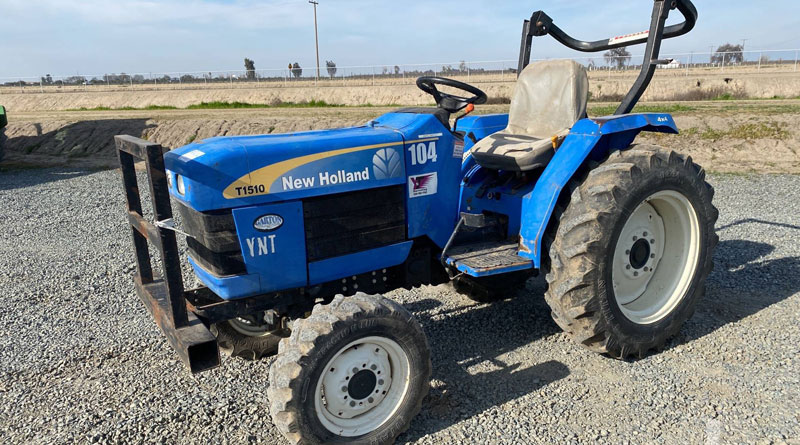
Utility tractors are workhorses. They sit between compact machines and full row-crop tractors — powerful enough for meaningful field work, sized to stay manageable for one-operator farms. Most run a two- or four-wheel-drive configuration and carry a category II three-point hitch.
Leading brands: John Deere 5 Series, Case IH Farmall, New Holland T5, Massey Ferguson 5700, Kubota M Series.
Key specs to compare:
– PTO horsepower vs. engine horsepower (look for 85%+ PTO efficiency)
– Cab vs. open station — cab models command 20–35% more at resale
– Transmission type: synchro shuttle, power shuttle, or CVT
Row-crop tractors (130–400+ HP)
Best for: Large-scale grain and row-crop farming — corn, soybeans, cotton, wheat.
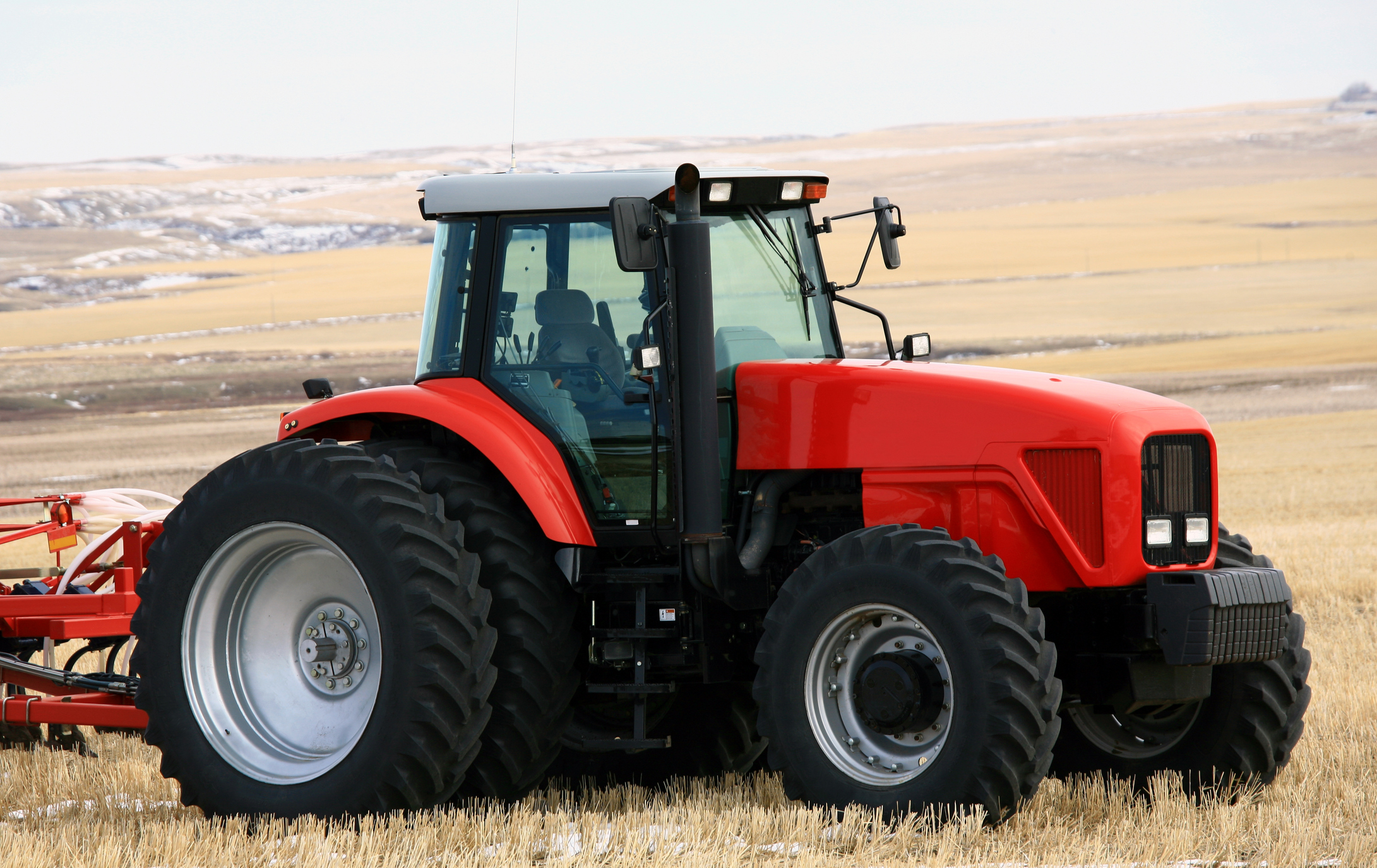
Row-crop tractors are the backbone of commercial grain farming. They’re built tall to clear canopy, narrow enough to straddle rows, and powerful enough to pull multi-section planters, cultivators, and sprayers. GPS guidance and precision ag integration are now standard on late-model units.
Leading brands: John Deere 6R, 7R, and 8R Series, Case IH Magnum and Puma, New Holland T7 and T8, AGCO Fendt 700 and 800 Vario, Massey Ferguson 8S.
If you’re sourcing agricultural tractors for a grain operation, row-crop machines represent the deepest inventory in the used market — and the widest price spread based on hours, spec level, and guidance system status.
Four-wheel drive (articulated) tractors (300–600+ HP)
Best for: Large-scale tillage, dryland farming, and high-acreage operations requiring maximum drawbar pull.
Articulated 4WD tractors — sometimes called duals — are the largest wheeled tractors built. They articulate at the centre frame rather than steering through the front axle, which gives them exceptional manoeuvrability at their size. They’re almost exclusively used in large commercial grain and dryland operations.
Leading brands: John Deere 9R Series, Case IH Steiger and Quadtrac, New Holland T9, AGCO Fendt 1100 MT.
Resale note: These machines carry high six-figure price tags new. Hours, tyres (or track condition on Quadtrac/MT models), and transmission service history are the primary value drivers at auction.
Track tractors (compact to large)
Best for: Soft or wet soils, hillside operations, and applications where ground compaction is a concern.
Track tractors replace rear wheels — or all four wheels — with rubber tracks. They distribute weight over a larger footprint, which reduces soil compaction and improves traction in wet or loose conditions. Compact track tractors are common in landscaping and orchards; large track units (like the Case IH Quadtrac) are used in commercial farming.
Leading brands: John Deere 8RT and 9RT, Case IH Quadtrac, Challenger MT Series, Kubota SVL (compact).
Buying consideration: Track replacement is expensive — budget $15,000–$50,000+ per set on large machines. Always check track wear percentage before bidding.
Orchard and vineyard tractors
Best for: Tree fruit, grape, and specialty crop operations with narrow row spacing and low-clearance requirements.
These are purpose-built narrow tractors — typically under 60 inches wide — with low-profile hoods and enclosed fenders to protect both operator and crop. They’re a niche category but command strong residual values due to limited production volumes.
Leading brands: John Deere 5E Narrow, New Holland T4V, Kubota L Narrow, Antonio Carraro, Fendt 200 Vario.
Industrial tractors
Best for: Construction sites, material handling, and non-agricultural ground engagement.
Industrial tractors share DNA with farm tractors but are configured for heavier loader work, site prep, and utility tasks on job sites. They typically run reinforced frames, industrial-spec tyres, and simplified transmissions tuned for repetitive loader cycles rather than field passes.
If you’re evaluating industrial tractors for fleet addition or resale, condition of the loader frame and front axle carry the most weight in valuation — these machines work hard in one spot rather than covering ground at low load.
Leading brands: John Deere 310 and 410 Backhoe Loaders, Case 570 and 580, New Holland B Series, Caterpillar 416–450 Series.
Quick reference: tractor types by HP and primary use
| Type | HP Range | Primary Use |
|---|---|---|
| Compact Utility | 15–60 HP | Hobby farms, landscaping, small property |
| Utility | 45–130 HP | Mid-size farms, hay, livestock |
| Row-Crop | 130–400+ HP | Grain and row-crop farming |
| Articulated 4WD | 300–600+ HP | Large-scale tillage, dryland farming |
| Track | 50–600+ HP | Wet soils, hillside, low-compaction |
| Orchard/Vineyard | 30–100 HP | Specialty crops, narrow rows |
| Industrial | 50–150 HP | Construction, material handling |
| Municipal | 45–130 HP | Road, parks, government fleet |
Knowing your tractor type before you bid saves time, prevents spec mismatches, and sharpens your price ceiling. Whether you’re adding to a working fleet or buying for resale, the used market rewards buyers who understand exactly what category they’re in — and what drives value within it.


 |
Floor Cleaning Machines: A practical buyer’s guide to types, specs & value |



Ritchie Bros. is a one-stop-shop for everything your equipment and truck business needs to succeed - buying and selling solutions, market insights and valuation, global buyer demand, and fleet management tools.
Ritchie Bros., Two Westbrook Corporate Center, Suite #1000 Westchester, Illinois, 60154 | +1.800.663.8457