
Adam Lawrence of Ritchie Bros. joins industry leaders panel at CONEXPO 2026
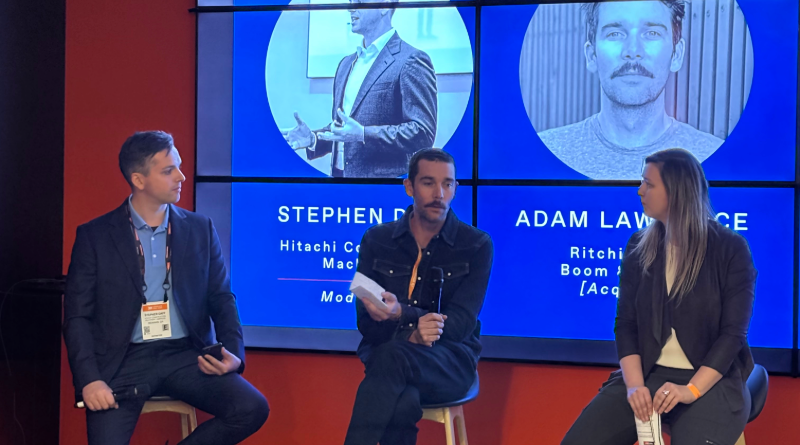
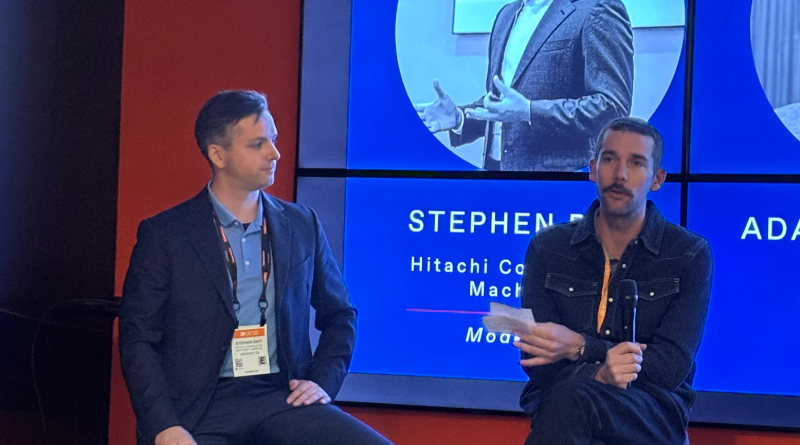
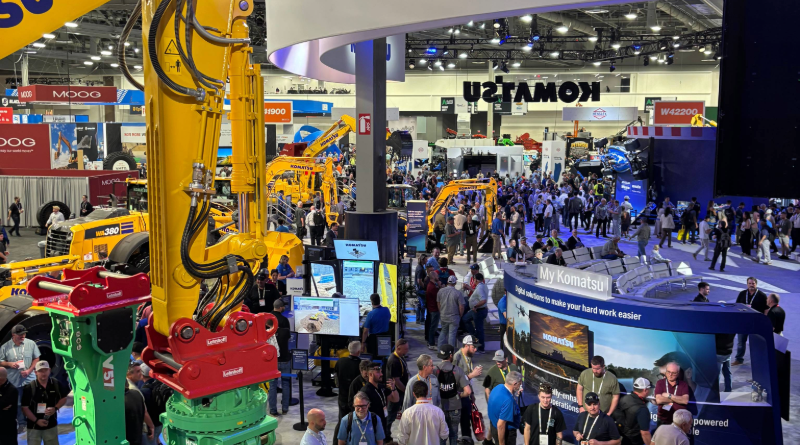
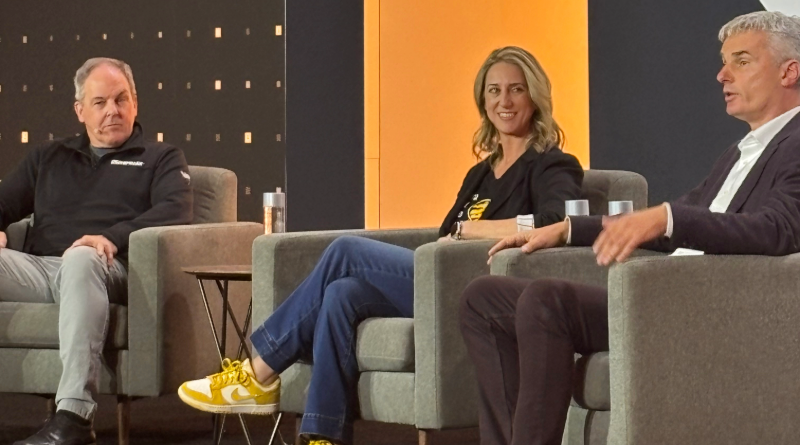
At CONEXPO 2026, entrepreneurs and industry leaders gathered at the Hitachi stand for a fireside chat called “Inside the Connected Jobsite,” co-hosted by Suffolk Technologies and LANDCROS Innovation Studios. Among the panelists was Adam Lawrence, founder of Boom & Bucket and now VP of Marketplace Growth with Ritchie Bros.
Adam shared his perspective on the challenges of building a business, an evolving industry’s perspective on data, and how technology is finally breaking the “we’ve always done it that way” mentality.
On the transition from ‘feelings’ to data
Q: You’ve seen the industry evolve significantly over the last few years. How has the conversation around equipment management changed?
Adam Lawrence: We’ve gone from feelings to spreadsheets. It used to be that a machine in the field was just a machine. Now, that machine is a data producer that feeds directly into its own lifecycle. When we talk to customers today, the question isn’t just “What is my machine worth?” it’s “When should I sell it based on the data it’s producing?” Even smaller rental companies and general contractors are starting to adopt this ROI-focused conversation that was once reserved for only the largest “best-in-class” operators.
Q: Is the industry actually applying this data yet, or are we still just collecting it?
Adam Lawrence: A few years ago, the question was, “We have all this data, now what?” Today, they are actually applying it to lifecycle management. They are leveraging operational data—telematics, usage, and service history—and tying it directly to financial market data to make smarter disposition decisions.
On the challenges of innovation
Q: We hear that “going to market” is particularly difficult for tech startups in construction. Why is that?
Adam Lawrence: Modern construction is predicated on risk mitigation. New technology changes a project’s risk profile, and that’s scary. If you’re a startup, you have to figure out how to lower the impact of trying something new. How can a customer test your tech without ruining their operations if something goes wrong? It’s a hard problem to solve, but it has to be done through partnership.
Q: Is the adoption slow?
Adam Lawrence: Breaking the “we’ve always done it that way” pattern is incredibly challenging. There are no shortcuts to grinding it out. In this industry, you have to prove your worth over quarters and years. You have to show that you were here last year, you’re here this year, and you’ll be here next year. For us, having strong reference customers who were willing to speak for us was the only way to bridge that trust gap.
On the future of the intelligent jobsite
Q: Where are you seeing the most exciting “intelligence” being applied right now?
Adam Lawrence: Personally, I’m excited about reducing the administrative burden. Construction has a massive “paperwork friction” problem—job order changes, field forms, inspections. Most digital versions of these are just “digital paper.” I’ve seen demos this week where AI is used to augment these workflows, giving people time back in the field to do their actual jobs. If we want to grow as an industry, we have to remove that administrative overhead.
Q: What is the “next step” for equipment data?
Adam Lawrence: Right now, it’s too fragmented. It’s often strictly vertical within an OEM. The opportunity for the future is a platform approach. Something that ties these silos together across an entire company, from the field to the finance office.
On the reality of building a business
Q: What was your experience building and selling a company in this industry? What is your perspective on being a founder in the construction space?
Adam Lawrence: Can I swear? Honestly, it’s really hard for a bunch of reasons. There is a steep professionalization curve. To sell something now, you have to move past simple pitches and into deep ROI calculations, while navigating massive enterprise hurdles and building coalitions within a company just to get a “yes.”
When we started, our business was focused on asset disposition. Back then, so much of the industry was driven by “feelings.” A contractor would say, “I feel like we should sell this machine at 4,500 hours or 7,000 hours.” When you asked why, the answer was almost always: “Because we’ve always done it that way.”
Breaking that pattern is incredibly challenging. As a founder, you might think you’re smarter or that your “fancy technology” gives you an immediate advantage, but there are no shortcuts.
It’s about grinding it out and proving yourself over quarters. Often it’s years. You have to be able to say, “We were here last year, we’re here this year, and we’ll be here next year.” Consistency is the only way to build trust.
We got lucky early on by securing very strong reference customers. Having those early results allowed us to leverage into bigger and bigger clients. In this industry, peers look to each other. You need those case studies from people your customers respect.
Eventually, we sold to a company (Ritchie Bros.) that already had the brand reputation needed to solve the trust problem at scale. We were four years in at that point; we could have spent another 15 years building that kind of brand on our own. In this industry, if you don’t have that reputation, you’ll still be introducing yourself 10 years from now. It is a “grind-it-out” world for technology adoption.
Interested in more industry expertise or buying or selling used equipment with Ritchie Bros.? Get in touch with our team to learn more.


 |
Maximizing Returns: How equipment dealers are using auctions more intentionally |

Ritchie Bros. is a one-stop-shop for everything your equipment and truck business needs to succeed - buying and selling solutions, market insights and valuation, global buyer demand, and fleet management tools.
Ritchie Bros., Two Westbrook Corporate Center, Suite #1000 Westchester, Illinois, 60154 | +1.800.663.8457